Trang chủ Blog Trang 20

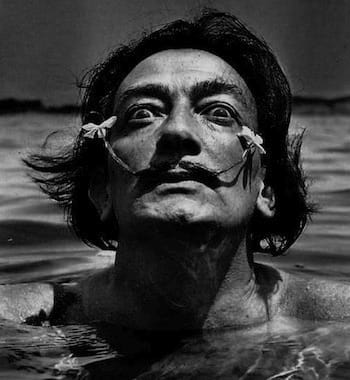
Salvador Dali: The Master Of Surreal Art

0
Screenshot

The Birth Of A Spanish Surrealist:

Salvador Dali was born in May 11 of 1904 in the humble town of Figueres, Spain. He shared the same first name with his older brother who had died 9 months earlier before he was born and had believed he was his brother’s reincarnation. Dali discovered his passion for art at a young age. He attended drawing school during the early years of his childhood and he also loved playing football like any other Spanish boy. Though he had interest in art, he was not serious in schooling and often daydreams during class. He was often ridiculed because of his eccentric fashion sense and an unusually long hair.

In 1922, he studied at the Academia de San Fernando and it was in this time that he developed a strong influence in many artistic styles such as Cubism and Metaphysics, to name a few. Later on, he drew controversy for criticizing most of his teachers and had allegedly started a riot in school and was eventually suspended and briefly imprisoned. He went back to the academy in 1926, but was expelled shortly after the examination believing that the school’s faculty were incompetent to examine him.

Dali continued his passion of Surrealism art. In 1929, he went to Paris and had a chance to meet with Pablo Picasso and some influential artist of that time. It is in this period that Dali focused on 3 artistic themes (Cubism, Impressionism, and Futurism) and these became evident on most of his paintings and collages. He did a lot of art pieces, but they were mostly criticized as having double meanings such as sexual symbolism and ideographic imagery. Though he was not favored by many, these criticisms only fuelled him to go on with his passion.

After some time, Salvador Dali got a chance to share his mastery of surrealism on the stage and into the silver screen. Some of his notable artworks are included in the “Mariana Pineda” play of 1927 and in the “Bacchanale” ballet of 1939; He was also able to grace some classic movies such as “Spellbound” by Alfred Hitchcock (his paintings were used in the ‘dream sequence’ of the movie) and in Walt Disney’s short film “Destino”.

During the next succeeding years, Dali painted on big canvasses depicting themes of history, science, and religion. He called this period as “Nuclear Mysticism”. He was also focused into creating the Dali Teatro Museo which he had successfully established, but also became the reason for his financial downfall.

In the 1980’s, Salvador Dali was forced to retire from this painting because of a disease which caused his hands to tremble and weaken. He then suffered deep depression after his wife, Gala died on June 10, 1982. The great Salvador died on January 23, 1989 lying on a hospital bed due to heart failure. He was then buried into the theater-museum’s crypt, and then his life and works became known to the world.

Dali’s Contribution To Art:
Salvador Dali is known to be a Surrealist and depicting this theme through his paintings and other art works. Most of his works show a sort of dream sequence which he often draws hallucinatory characters. His major contribution to the Surrealist movement is called the “Paranoiac-Critical Method” which is a form of mental exercise of accessing the subconscious parts of the mind to have an artistic inspiration. He used this method to realize the dreams and imagination ha have in his mind, changing the real world the way he wanted and not necessarily what it was.

Conclusion:
Salvador Dali was once known to be a peculiar man often doing eccentric paintings. Though he was once mocked and criticized by his artistic methods, he still left an important contribution to the Surrealist movement and will continue to be an inspiration to the many artists of today and tomorrow.

For more information about Dali’s Painting The Persistence of Memory, please visit our website at www.dalipaintings.com.

Article Source: http://EzineArticles.com/9585627
Source by Brent Tan

Immortal Picasso Paintings

0

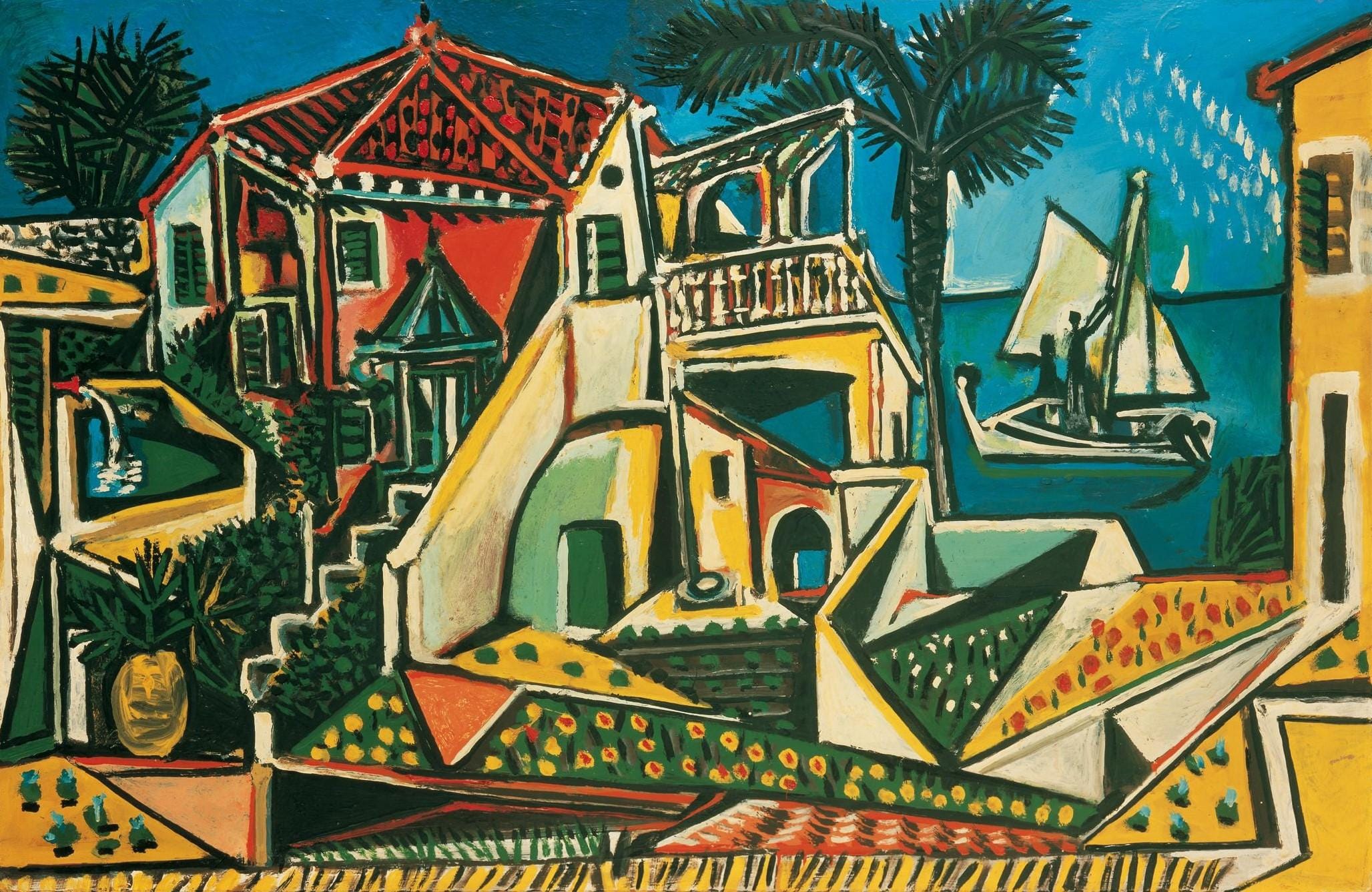
Our world is sometimes blessed by the legacy left behind by artists who weave magic with their talent. Picasso’s paintings are a reflection of the magic Pablo Picasso wove in his time. A Spanish painter and sculptor who left his indelible mark on the 20th century, Picasso continues to survive in the hearts and minds of countless artists through his paintings.

The Treasure Of Picasso’s Paintings

Picasso paintings exhibit a soul of their own and are renowned for their realistic look. They have been placed in different periods of his painting career namely, the Blue, the Rose and the Cubist periods. These paintings showcase Picasso’s immense talent and his fearlessness as a painter experimenting with different techniques and ideas.

Picasso loved to paint dead nature, musical instruments and friends. He went beyond the rules of academics, exploring the painting art in his own way. His paintings often broke the cliches of tradition and stood tall and proud displaying a uniqueness of their own. Some notable paintings of Picasso include The Two Saltimbanques (Harlequin And His Companion, 1901), Gertude Stein (1906), Les Demoiselles d’ Avignon (1907), Guernica (1937) and Weeping Woman (1937).

Picasso’s ‘Guernica’ deserves a special mention as this painting is considered to be a powerful statement in politics. Depicting the suffering and war induced tragedy, this work is truly monumental and a combination of two styles, epic and pastoral.

Paintings from Picasso’s Blue period are believed to have taken birth from his state of mind following the death of his friend Casamegas and express a state of melancholy. These paintings are characterised by their monochrome and cold effects, the coldness highlighted by the clever use of blue color. ‘La Vie’, ‘Evocation’, his ‘Self Portrait’ are the names of a few paintings from this period.

Paintings like ‘Garcon a la Pipe’, ‘Woman With Crow’, ‘Acrobat With Young Harelequin’ and ‘Girl In Chemise’ are from Picasso’s Rose period and often feature local people and characters from the entertainment industry. In contrast to the downbeat Blue period, The Rose period paintings led to the birth of a typical ‘Picasso’ style and were optimistic in their mood.

Paintings like the ‘Three Musicians’ and ‘Guitar’ marked the Cuban period of Picasso’s art. The paintings depicted a transition of forms, from natural to geometric and angular. Multi-view figures also took shape mainly in dull colors and redefined Picasso’s paintings.

It has been proven, time and again, throughtout the art community of the world and otherwise that there was something special about Picasso’s paintings. His paintings speak for themselves and come alive in more ways than one. They happen to be a status symbol of sorts and are a prized possession anywhere, anytime.

Paintings by Picasso were never amateur. His art developed gradually, in phases, brightened and strengthened by experience and genuine talent. His expression of raw emotions took one’s breath away and left one and all craving for more.

Pablo Picasso himself said, “Are we to paint what’s on the face, what’s inside the face or what’s behind it?” His paintings redefined every face and finally contributed immensely to the face of the painting fraternity. Here’s to all Picasso paintings that continue to enchant and fascinate us.


Thế giới của chúng ta đôi khi được ban phước bởi di sản mà các nghệ sĩ để lại, những người đã dệt nên điều kỳ diệu bằng tài năng của họ. Tranh của Picasso là sự phản ánh của phép thuật mà Pablo Picasso đã dệt nên trong thời đại của ông. Là một họa sĩ và nhà điêu khắc người Tây Ban Nha đã để lại dấu ấn không thể phai mờ của mình trong thế kỷ 20, Picasso vẫn tiếp tục tồn tại trong trái tim và tâm trí của vô số nghệ sĩ thông qua các bức tranh của mình.

Kho báu của các bức tranh của Picasso

Tranh của Picasso thể hiện một tâm hồn riêng và nổi tiếng với vẻ ngoài chân thực. Chúng đã được đặt trong các giai đoạn khác nhau trong sự nghiệp hội họa của ông, cụ thể là thời kỳ Xanh lam, Hoa hồng và Lập thể. Những bức tranh này thể hiện tài năng to lớn của Picasso và sự không sợ hãi của ông với tư cách là một họa sĩ thử nghiệm các kỹ thuật và ý tưởng khác nhau.

Picasso thích vẽ thiên nhiên chết chóc, nhạc cụ và bạn bè. Ông đã vượt ra ngoài các quy tắc của học thuật, khám phá nghệ thuật hội họa theo cách riêng của mình. Các bức tranh của ông thường phá vỡ những khuôn mẫu truyền thống và đứng cao và tự hào thể hiện sự độc đáo của riêng chúng. Một số bức tranh đáng chú ý của Picasso bao gồm The Two Saltimbanques (Harlequin And His Companion, 1901), Gertude Stein (1906), Les Demoiselles d’ Avignon (1907), Guernica (1937) và Weeping Woman (1937).

‘Guernica’ của Picasso xứng đáng được nhắc đến đặc biệt vì bức tranh này được coi là một tuyên bố mạnh mẽ về chính trị. Miêu tả nỗi đau khổ và bi kịch do chiến tranh gây ra, tác phẩm này thực sự hoành tráng và là sự kết hợp của hai phong cách, sử thi và đồng quê.

Người ta tin rằng các bức tranh từ thời kỳ Blue của Picasso bắt nguồn từ trạng thái tinh thần của ông sau cái chết của người bạn Casamegas và thể hiện trạng thái u sầu. Những bức tranh này được đặc trưng bởi hiệu ứng đơn sắc và lạnh lẽo, sự lạnh lẽo được làm nổi bật bởi việc sử dụng màu xanh lam một cách khéo léo. ‘La Vie’, ‘Evocation’, ‘Self Portrait’ của ông là tên của một số bức tranh trong thời kỳ này.

Những bức tranh như ‘Garcon a la Pipe’, ‘Woman With Crow’, ‘Acrobat With Young Harelequin’ và ‘Girl In Chemise’ thuộc thời kỳ Rose của Picasso và thường có sự góp mặt của người dân địa phương và các nhân vật trong ngành giải trí. Trái ngược với thời kỳ Blue buồn tẻ, các bức tranh thời kỳ Rose đã dẫn đến sự ra đời của phong cách ‘Picasso’ điển hình và có tâm trạng lạc quan.

Những bức tranh như ‘Three Musicians’ và ‘Guitar’ đánh dấu thời kỳ Cuba của nghệ thuật Picasso. Các bức tranh mô tả sự chuyển đổi của các hình thức, từ tự nhiên sang hình học và góc cạnh. Các hình đa góc nhìn cũng chủ yếu được định hình bằng màu sắc xỉn và định nghĩa lại các bức tranh của Picasso.

Đã được chứng minh, hết lần này đến lần khác, trong cộng đồng nghệ thuật trên thế giới và những nơi khác rằng có điều gì đó đặc biệt trong các bức tranh của Picasso. Các bức tranh của ông tự nói lên điều đó và trở nên sống động theo nhiều cách. Chúng tình cờ là một biểu tượng địa vị và là một vật sở hữu quý giá ở bất cứ đâu, bất cứ lúc nào.

Các bức tranh của Picasso không bao giờ là tranh nghiệp dư. Nghệ thuật của ông phát triển dần dần, theo từng giai đoạn, được làm sáng tỏ và củng cố bởi kinh nghiệm và tài năng thực sự. Cách ông thể hiện cảm xúc thô sơ đã khiến người ta phải nín thở và khiến mọi người khao khát được khám phá thêm.

Bản thân Pablo Picasso đã nói, “Chúng ta sẽ vẽ những gì trên khuôn mặt, những gì bên trong khuôn mặt hay những gì ẩn sau nó?” Những bức tranh của ông đã định nghĩa lại mọi khuôn mặt và cuối cùng đã đóng góp rất nhiều cho khuôn mặt của cộng đồng hội họa. Xin gửi lời chúc đến tất cả những bức tranh của Picasso vẫn tiếp tục làm chúng ta say mê và thích thú.

To know more about the life and painting of Pablo Picasso Paintings, please visit us at http://www.pablopicasso.org.

Article Source: http://EzineArticles.com/7262410

Source by Brent Tan

Short Introduction to Salvador Dali’s Painting “The Persistence of Memory”

0


the-disintegration-of-the-persistence-of-memory and the-persistence-of-memory 1931

Salvador Dali’s The Persistence of Memory is one of his most cherished works from a prolific lifetime. It was painted in 1931 long after he attended art school in Madrid and Barcelona. His early work throughout his education reflects an unusual aptitude for a wide variety of styles.

In the 1930’s Dali’s unparalleled ability as an artist was combined with his discovery of Sigmund Freud’s teachings about subconscious imagery, and his recognizable mature style was introduced to the world. Before painting The Persistence of Memory Dali had also become acquainted with the Paris Surrealists. He felt enabled to create groundbreaking art that would establish the reality within the subconscious.

The iconic imagery of the melting pocket watch has made The Persistence of Memory one of Dali’s most recognizable paintings. The painting is a splendid example of the contrast between sharp hard lines and melting softness. The watches themselves symbolize the concept of time past, and perhaps the irrelevance of time in the universe. Dali may have been commenting on the Surrealist interpretation of Albert Einstein’s theory of relativity.

Dali painted an abstract human figure in the middle of the composition that some interpret as a self-portrait. This bizarre figure is a recurring visitor in his work, and represents a soul that travels within both the realms of reality and the subconscious. Dali often drugged himself into hallucinatory states, and spent a great deal of time exploring his subconscious. The figure in the painting has only one closed eye which suggests a dream-state.

Ants crawl over a clock at the bottom left of the painting. Dali often painted ants to symbolize decay. This effectively ties in the mortal plane to work that is clearly a depiction of the subconscious.

It is likely that the clocks was used by Salvador Dali to symbolize mortality instead of literal time. And the cliffs that provide the backdrop are the impression of part of Catalonia, which was Dali’s childhood home.

This is rather a small painting, at least not as large as you would think. While this painting is one of Dali’s biggest triumphs, the actual size of this oil on canvas painting measures only 9 1/2″ x 13″.

This painting was first shown at the Julien Levy Gallery and has been part of the collection of the Museum of Modern Art (MoMA) in New York City since 1932, thanks to an anonymous donor.

Source by Brent Tan

Haifa Kamal releases “A Córdoba” – a flawless collision of Arabic ballads and Flamenco music

0


With her calming voice that flies over the world of flamenco along with the enchanting guitar rhythms, Haifa Kamal, an independent Jordanian singer, releases her mini-album “A Córdoba” (English: To Cordoba) in collaboration with Obaider, a Palestinian-founded Spanish flamenco band.

Three songs are released in this mini album on various digital music platforms, such as Anghami, Spotify, iTunes, YouTube, and SoundCloud, with each song including a ballad from a different era. While “Shamsu Ennahari” is by Safi Al Din Al Hilli, a fourteenth-century Arab poet, “Asafa Al Hawa” is by Sumaya Saleh, a contemporary Syrian poet, and “En Konta” is by eighteenth-century poet and priest, Nicolas Al Sayegh Al Halabi.
The melodic Spanish tunes that accompany Kamal’s soothing voice are composed and arranged by Obaider, an independent Palestinian band founded by Baider Burman and Obai Al Bitar. Musicians from Spain and Sweden alongside Obaider are behind the tunes of both “Shamsu Ennahari” and “Asafa Al Hawa,” while “En Konta” is composed and arranged by Alvaro Llanos, the bass guitarist in the band. 
This iconic team has worked on the album since the outbreak of the coronavirus at the beginning of 2020. Difficult production conditions were imposed due to the lockdowns brought by the pandemic, which extended the music recording for months. With few hours in hand not controlled by quarantine, musicians participating from Spain, Sweden, Jordan, and Qatar found time to work on the project.
The musicians include Haifa Kamal as lead singer, Baider Burman, and Obai Al Bitar on the guitar, Alvaro Llanos as bass guitarist, Manuel Arango on the percussion, Yehia Najem and Alexandra Shabo as backing vocals, along with Najati Al Suloh managing the production.
Haifa Kamal, who aspires to present a new style in each of her projects, adds in this album a new color to her musical career. Like all of her previous productions, this production is also considered independent. She has previously produced “Denya”, an independent album in 2014, and “#TheEDMProject” in 2018, in addition to dozens of singles between her first album and the last one, released this year.
Despite its higher cost and longer completion time, Haifa Kamal says that she prefers independent production. This is because she can not only manage the quality but also seek diversity in each of her works. While this “independency” releases her from the stress of being limited to what is usually required from production companies, it also allows her to shape her musical identity.
It is worth noting that Kamal holds a bachelor’s degree in music from the National Music Conservatory – Jordan, with a concentration in Arabic singing. Although she released her first album in 2014, the beginning of her music career goes way back. Her father, the Palestinian composer and musician Kamal Khalil, discovered her talent when she was six. Since then, she became the youngest lead singer of his band, Baladna. She has also participated in several music projects, such as the Rum Tariq Al-Nasser Group, the Amman Band for Arabic Music, and the National Institute of Music Orchestra, as well as singing different theme songs for Arabic drama series such as “Laysa Saraban”, “Wish Raja’ak”, “Al Aswar”, “Samarkand” and others.
Kamal has also participated in many local music festivals such as Jerash Festival and Fuheis Festival in Jordan. She has also made an appearance in international festivals in Scotland, Cyprus, Tunisia, Opera House in Cairo, Qurain Festival in Kuwait, Opera House in Damascus, and National Day celebrations in the United Arab Emirates.
Obaider is a Palestinian band founded by Baider Burman and Obai Al Bitar, with the participation of musicians from Spain and Sweden. Mixing between Arabic poetry and Spanish Flamenco music, this Andalusian- style band brings different music tastes from all around the world together. They aim not only to show the beauty of the Arabic language but also to allow the youth to reach the language from a different perspective.


Listen on Spotify
Listen on Youtube here.
https://www.youtube.com/watch?v=/iZHfvff768w

Adam Bailey

Author: Adam Bailey
Adam is a regular contributor for established press release distribution website Release-News.com. He writes on a wide range of topics including music.


Source link

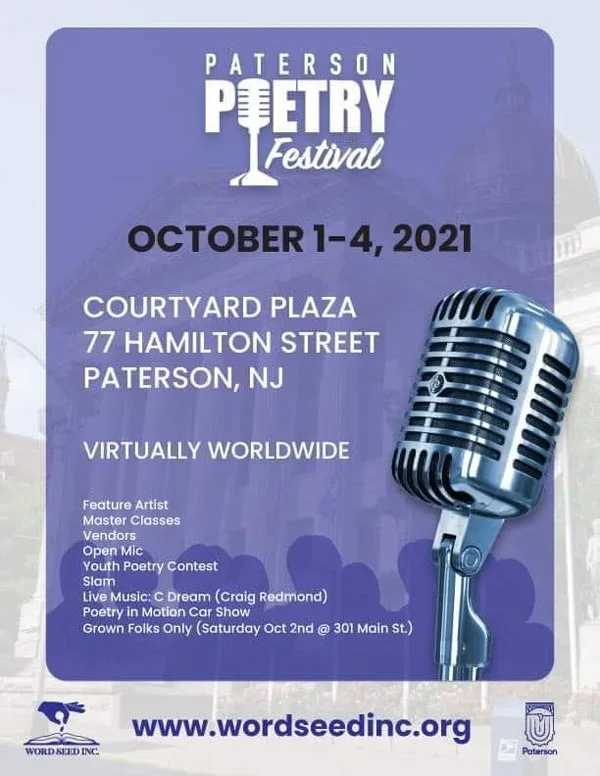
2021 Paterson Poetry Festival To Run October 1-4

0
2021 Paterson Poetry Festival To Run October 1-4

NEWS | FEATURES | PREVIEWS | EVENTS

originally published: 08/17/2021

2021 Paterson Poetry Festival To Run October 1-4

(PATERSON, NJ) — WORD SEED INC (NJ), New Jersey’s Premiere Poetry Event, the Paterson Poetry Festival 2021 returns to Paterson, New Jersey. The Festival will feature a large range of poetry and literary events LIVE and FREE (some events will have registration fees) to the public at 77 Hamilton St, Paterson, NJ 07505. Poets and artists will come together physically and virtually bringing poetry and the literary arts to the masses October 1-4. This year’s event features poets and literary artists from around the world including Kenya, India, Canada, and several states in the US representing both coasts, and both the northern and the southern states.

Word Seed Inc. Founder, President and Paterson Poet Laureate, Talena Lachelle Queen, said “It is my greatest joy to uplift others. The Paterson Poetry Festival is an uplifting of voices, causes, and a celebration of things that matter.” 

Each year the festival hosts Open Mic, SLAM Contest, Youth Poetry Contest by submission, Poetry in Motion Car Show, Master Classes, Homage hour (Speak Series), Vendors, Food Trucks, Lit Land (interactive place for very young children), Free books and activities for all. The C Dreams band led by Craig Redmond of Paterson is set to play at the event on opening night.

2021 Paterson Poetry Festival To Run October 1-4

“Celebrating the written word through performance and community are the pillars of Word Seed, Inc. The collaboration to include international artists  and a hybrid environment for virtual and in person attendees and performers is a new dimension for the 2021 Paterson Poetry Festival and it can only grow from here” said Word Seed Inc Vice President, Co-Chair of the Paterson Poetry Festival and Jersey City Poet Laureate Rescue Poetix ™. 

The festival takes place on October 1st from 5:00pm – 8:30pm, October 2nd from 10:00am – 8:00pm both in person and virtual, October 3 from 12:00pm – 5:00pm, and October 4 (virtually) 6:00pm – 9:00pm.  

 Advertise with New Jersey Stage for $50-$100 per month, click here for info


The Paterson Poetry Festival is an annual event in celebration of words, writers and poetry lovers. The Festival was founded in 2018 and has been hosted ever since on the stairs of the Historic Passaic County Courthouse in downtown Paterson. The multi day event includes the Poetry in Motion Car Show with the Classic Riderz Car Club, The Paterson Poetry Festival Slam with a cash prize, Open Mic, The Speak Series/ Homage Stage, Lit Fest ( creative fun space for young kids), Youth Poetry Contest, Master Classes, Award ceremonies, vendors, and food. The Paterson Poetry Festival is the super bowl event for poets. People have traveled from all parts of the country to be part of the Paterson Poetry Festival that includes a bit of every artistic expression including visual arts, music and crafts.

“While we celebrate the written and spoken word each year, we are also celebrating community; and it takes a community of volunteers and dedicated supporters to make a great festival.” Children’s author Felicia Capers explained. 

The Word Seed, Inc. mission is to give voice and support to writers of every age and skill level within our diverse communities. We start with the seed which is basic literacy in very young children and continue our exploration into the many blooms and blossoms that language becomes as an artistic expression of the mature writer.

Advertise with New Jersey Stage for $50-$100 per month, click here for info


Source link

Post-Spiritual Abstraction – Trừu tượng Hậu Tâm Linh

0
Bài viết của Nancy Princenthal | Ngày 17 tháng 8 năm 2021, 15:40
Hình ảnh triển lãm “Hilma af Klint: Những bức tranh cho tương lai”, năm 2018, tại Bảo tàng Guggenheim, New York.Ảnh: David Heald/©2018 Quỹ Solomon R. Guggenheim
View of the exhibition “Hilma af Klint: Paintings for the Future,” 2018, at the Guggenheim Museum, New York.Photo David Heald/©2018 The Solomon R. Guggenheim Foundation

Being absorbed in visual abstraction has been, traditionally, a very good way to get some quiet. Whether besieged by a once again noisy culture, a relentlessly beckoning internet, or just our own yammering minds, there is plenty of reason to long for wordless, lumen-less art—for obstinately mute and immobile paintings and sculptures without namable content.

Alas, it is not to be. As is evident in a spate of recent exhibitions and publications, including modern and contemporary art scholar Pepe Karmel’s new book offering a global survey of the subject, abstraction has lately grown exceedingly jumpy. And voluble.

Conspicuous among its agitating energies is a revived spiritualism, headlined by the runaway fame of Hilma af Klint, whose 2018 exhibition at the Guggenheim Museum in New York shattered attendance records. According to many observers, it also smashed the long-established timeline for pure abstraction, pushing it back at least to 1907, when af Klint produced—under the guidance of otherworldly spirits, she said—whimsically majestic compositions that predated Malevich’s and Kandinsky’s abstract paintings of the following decade. Other early spirit-guided artists have been quickly dusted off, as in the well-received “Not Without My Ghosts: The Artist as Medium,” a 26-person exhibition that took place at the Drawing Room in London in 2020; notable among early, fully abstract contributions were Georgiana Houghton’s swirling effusions of the 1860s. The acclaimed survey “Agnes Pelton: Desert Transcendentalist,” which opened in 2019 at the Phoenix Art Museum before traveling to the Whitney Museum in New York the following year, presented a spiritually minded midcentury painter whose semi-abstractions glimmer spectrally with astral, floral, and landscape allusions.

While striking in its fervor, this big-tent revival is not the first of its kind. At the Drawing Center in New York in 2005, Catherine de Zegher organized “3 x Abstraction: New Methods of Drawing,” an exhibition linking, under the sign of nonsectarian faith, three linear abstractionists: af Klint, faith healer Emma Kunz, and Agnes Martin, also designated for the purpose a saint of the desert. Twenty years earlier, there had been the monumental “The Spiritual in Art: Abstract Painting 1890–1985,” organized by Maurice Tuchman for the Los Angeles County Museum of Art (and met with considerable skepticism at the time). Af Klint and Pelton are both featured in its massive catalogue, which ranges widely over what Tuchman, in the title of his keynote essay, calls “Hidden Meanings in The Spiritual in Art.” He admits at the outset that his effort to illuminate abstraction’s spiritual premises was hardly without precedent. And if the West Coast had long been especially hospitable to art that inclines toward transcendentalism—for instance, in the Light and Space installations of Robert Irwin and James Turrell—such leanings weren’t absent back East. The Dia Foundation, institutional seat of Minimalist materialism, also bears in its DNA the mystical Sufism practiced by its founders, Heiner Friedrich and Fariha al Jerrahi (née Philippa de Menil). Moreover, as Tuchman pointed out, the Theosophy that af Klint and Pelton practiced was shared by a host of early modernists, Mondrian and Kandinsky among them. The latest effervescence of such cosmic tendencies is, arguably, the mostly high-tech spectacles featured in the new Superblue venture in Miami, which like Yayoi Kusama’s wildly popular mirror rooms, offer blissed-out, interactive immersive experiences—not altogether different in purpose from historic forms of sacred ritual—by artists ranging from Turrell, Mary Corse, and Nick Cave to Jacolby Satterwhite and teamLab.

If the current alliance of abstraction with nonsectarian spiritualism is nothing new, the question nonetheless arises of why it is now thriving. Perhaps it is a warning: civilizations in decline often turn toward mysticism, for instance, the Hellenistic mystery cults of the post-Classical Mediterranean. Or it may signify the bad odor now hanging over secular humanism. Seen by some as too European and too smug, secularism is at the center of a cultural crisis in France, where the nation’s vaunted, philosophically foundational laïcité is pitted against the reality of a growing Muslim population, supported by those on the left favoring recognition of the country’s plural identity, a situation complicated by an enduring Catholic (and anti-Semitic) heritage. Even in the US, it is clear that politically conservative white Christians have no patent on religious devotion: here, too, a turn against secular humanism has taken place on the left, while the religious right remains, naturally, allergic to it as well. But then, strange bedfellows in cultural politics are nothing new.

In any event, spiritualism is a leading but hardly exclusive element in the thoroughgoing reevaluation of abstract art, which has—with good reason, I believe—made it increasingly difficult to ignore a work’s time and place, motivation, reception, and, above all, its latent content, in which all these conditions are reflected.

Agnes Pelton; Messengers; 1932; oil on canvas 28 by 20 inches
Agnes Pelton; Messengers; 1932; oil on canvas 28 by 20 inches; Collection of Phoenix Art Museum, Gift of The Melody S. Robidoux Foundation

By way of a guide to this state of affairs there is Karmel’s big, beautiful, and wholly nonlinear volume Abstract Art: A Global History (Thames & Hudson, 2020). It is premised on the conviction, stated at the start, that “abstract art is always rooted in experience of the real world.” An af Klint painting appears on the cover and is discussed in the introduction to “Cosmologies,” one of the book’s five main chapters, each further subdivided into unabashedly incommensurable categories; paragraph-long discussions of individual works, illustrated at large size, follow the essays that head the various sections. Malevich is in the “Cosmologies” introduction too, cited for his interest in interplanetary travel, and so is Johannes Itten, the charismatic Bauhaus professor who brought esoteric rituals into the school’s foundation course. With less conceptual grounding, Jackson Pollock’s painting Reflection of the Big Dipper (1947) and David Smith’s sculpture Star Cage (1950) are both illustrated and glossed under the subdivision “Star Charts”; illustrated here as well are installations by Kusama and Felix Gonzalez-Torres. Despite opening this chapter with a consideration of Christian mysticism, Karmel is concerned not with questions of belief but, as throughout this study, with a taxonomy of forms. Brimming with scholarship and insight, his survey is a network of linked fragments, a rhizome, a Wunderkammer—in short, a book for our times.

Karmel’s definition of his subject is generous. “There is no either/or relationship between abstraction and figuration,” he writes, qualifying that judgment only slightly by excluding outright illusionism. Indeed, figures abound. The chapter “Bodies” (which begins with Picasso) is divided into “Dancers, Athletes and Poets”; “Workers and Machines” (here he observes, pungently, that “geometric abstraction was the artistic equivalent to Fordism”); “Embryos and Blobs”; “Totems”; “ Presences” (Alberto Giacometti and Louise Bourgeois); “Skins and Folds”; and “Organs and Fluids” (Kiki Smith, Lynda Benglis, Terry Winters, Carroll Dunham). There is a kind of cracked poetry to Karmel’s categories, which recall the passage from Borges that famously opens Michel Foucault’s The Order of Things; Borges describes an apocryphal encyclopedia in which animals are divided into a list that begins: “(a) belonging to the Emperor, (b) embalmed, (c) tame, (d) sucking pigs, (e) sirens, (f) fabulous, (g) stray dogs.” The thing we learn from “the exotic charm of [this] system of thought,” Foucault adds, “is the limitation of our own.” Clearly, it is a lesson still to be absorbed.

Karmel’s own intention, he writes, is to undermine the Hegelian notion of a progressive art history led by inner necessity and carried forward by heroic individuals. And while some such individuals are nonetheless wheeled onto the stage, they are allowed a measure of doubt. When Rothko declares, “I’m not an abstractionist,” but instead a painter “of basic human emotions: tragedy, ecstasy, doom, and so on,” it is the “and so on” that stands out to me, seeming to sheepishly temper his exorbitant, and now rather embarrassing, claims.

Apart from loosening the distinction between abstraction and other kinds of art by rooting it in social experience—David Reed is deemed a painter of “vortical landscapes,” who revives a Romantic motif to reflect “the abstract image of a world in perpetual motion” under the transforming effects of globalization; the flickering “vibratory field” seen in a painting by Roger Bissière is said to celebrate sheer survival, after the horrors of World War II—Abstract Art is dedicated to inclusivity. While old (or dead) white guys introduce most chapters, they’re followed by plenty of women and artists from all over. Karmel embraces the decorative arts, photography, and performance, as well as outliers of many kinds; he segues from Giacometti to Jasper Johns and Robert Morris, thence to dancer Simone Forti, and on to Michael Fried and his landmark essay on the theatricality of what came to be called Minimalism. One thing leads to another.

Karmel is not alone, of course, in looking to diversify the field. When the Museum of Modern Art in New York presented “Inventing Abstraction, 1910–1925” in 2012, the organizers were confident of the invention’s birthdate and place of origin (Europe, including western Russia): the emphasis on pure form was said to begin with Kandinsky, Delaunay, and Kupka. Since then, MoMA has made substantial efforts to mend its ways, for instance with its “Sur Moderno: Journeys of Abstraction” (2019), an overview of Latin American modernism.

In early 2020, New York University’s Grey Art Gallery presented “Taking Shape: Abstraction from the Arab World, 1950s–1980s.” One of the two shows inaugurating the Met Breuer in 2016 surveyed the career of Nasreen Mohamedi, a pioneering Indian abstractionist; later exhibitions there featured textile sculptures by Mrinalini Mukherjee; constructions by Jack Whitten, a once-neglected Black artist; and a survey of the Brazilian multidisciplinary abstractionist Lygia Pape.

The gender of abstraction, an implicit consideration in some of these shows, awaits its own survey. For many women, Minimalism’s formal austerity, with its staunch opposition to anything personal—narrative, touch, bodies, handcraft—confirmed that reductive abstraction was a man’s game. Condemning it in the 1974 essay, “An Autobiography of the Artist as an Autobiographer,” Eleanor Antin, a pioneering body artist and feminist, wrote, “An abstract painting is an alienated object whose value is determined by a complex set of cultural commitments remote from all human interest. In fact, one of the major components that goes into determining its art value is the degree of its remoteness.” In the 1960s and early ’70s, women abstractionists resisted this alienation with the use of textiles, ceramics, and other materials and processes associated with handcraft, and they favored the complexities of Pattern and Decoration, all now enjoying renewed attention. Even in its early years, Minimalism was sometimes seen as softened—hence feminized—by evidence of the artist’s hand at work. That is the case with the belatedly ascendant Agnes Martin, though she was no supporter of any links between her work and textiles, or women’s work, or for that matter, femininity itself.

By disposition and age, Martin, although romantically linked with women, was not inclined to endorse the queering of abstraction, either. But Carrie Moyer is. A painter whom Karmel categorizes under “Bodies” (subdivision, “Organs and Fluids”), Moyer asserted, in a recent online DC Moore Gallery conversation with figurative painter David Humphrey, that “modernism is still present. I’m still reacting to its don’ts, as a woman who is queer.” When Humphrey observed, “I feel your work has the voice of emphatic graphics, of public enunciation. It’s brassy,” Moyer readily agreed, linking those qualities to her early agitprop work for Dyke Action Machine! “I’m not interested in sharing a tender moment with the viewer,” she said. “It’s much more exclamatory than that.” But worrying that “everything is instrumentalized in our culture,” she wondered, “what does a painter do?”

Screen-Shot-2021-05-13-at-10.27.00-AM
Sam Gilliam: Double Merge, 1968, acrylic on canvas; at Dia:Beacon, New York. Photo Bill Jacobson Studio/©Sam Gilliam/Artists Rights Society (ARS), New York 

One answer for abstractionists (though not for painters) is provided by Theaster Gates, a leading proponent of hybridizing craft and social practice. A skilled ceramist, Gates makes his own imposing and very beautiful ceramic sculptures; he has also organized community-based ceramics workshops that generate marketable products. The role of the headlining artist is contested, or at least rendered uncertain, in such collaborative projects. The same can be said about the practices of af Klint and Houghton, if we accept that they were, in any sense, led by spirits of the departed. These notions also apply to early Surrealism’s reliance on what André Breton called “psychic automatism,” a maneuver for evading conscious reflection that similarly led to things like cursive linear abstractions liberated from discernible meaning.

If it’s not the thinking mind (or ghosts) at work, who or what is it? How artists have construed the subconscious over the past century and more is a big, deep question. Many artists, abstract and figurative ones alike, confirm that their hands operate independently of conscious deliberation; many also describe imagery that comes to them unbidden, in vivid inspiration or in dreams. And then we have more than fifty years of argument that all art is a vessel for the creative energy that flows through a culture—or, just as often, reflects its blockage. Art historian Christa Robbins aims, in her new book, Artist as Author (University of Chicago Press, 2021), to “return to artists some of the agency that the ‘death of the author’ has denied them.” Her penetrating analysis centers on mid-twentieth-century abstractionists of the New York School, diving deep into the closely argued definitions of individual “action” put forward principally by Harold Rosenberg, and diversely exemplified by Jack Tworkov, Helen Frankenthaler, Sam Gilliam, and others. But this is no bid for finding personal meaning in abstract painting. Robbins contends that the artistic action in question is a matter of placing oneself in the formal and intellectual forward march of modern art. The “author” she has in mind is not defined by internal, emotional experience; on the contrary, Robbins approvingly quotes Rosalind Krauss’s 1972 complaint against “the psychologizing whine of ‘Existentialist’ criticism.” In a concluding discussion of (once again) Agnes Martin, Robbins argues that the self-identified Abstract Expressionist exemplified her peers’ investment in a “practiced relation to self, which places an emphasis on authorship as a site of inquiry and exploration.” In other words, the meaning of Martin’s grids is in the practice of their making—a labor that involves a physical process but also the “habits of mind and body.”

As is clear from all the preceding, a final question arises about whose attribution of meaning counts, since artist, viewer. and critic seldom agree. Reviewing the New Museum’s recent exhibition “Grief and Grievance: Art and Mourning in America,” Peter Schjeldahl enthused in the New Yorker about the stormy brushwork, glowing color, and majestic scale of paintings by Julie Mehretu and Mark Bradford, who he said represent a “resurgence of American art’s modern breakthrough after six decades in abeyance.” By contrast, Holland Cotter, writing about the same show for the New York Times, drew attention to these paintings’ underlying political content: government surveillance maps of Black neighborhoods in Los Angeles issued after the 1965 Watts uprising, in Bradford’s case, and in Mehretu’s, a “half-hidden” image of the 2017 white supremacist rally in Charlottesville, Virginia. To many viewers (myself included), both of these buried images were completely invisible. But knowing about them does vivify, or at least complicate, the artists’ works.

This is where the exhibition’s catalogue (and other explanatory material) comes in, providing the kind of information offered in Karmel’s book. The dismissal of pure formalism—and of the academic language supporting it—has, clearly, made room for an avalanche of political thought, social and cultural history, and biographical detail that visual evidence alone doesn’t reveal. In “The Circle with a Whole in the Middle,” a 2020 essay on Gilliam, examples of whose unstretched canvases are now on long-term view at Dia Beacon, theorist Fred Moten alludes to Ornette Coleman’s rhythms, to the “unseen, stolen work” of Black women hanging clothes out to dry, and to Gilliam’s “tenting and billowing of tint.” But Moten also suggests, “If you don’t try to get anything out of [Gilliam’s work], you can be drawn in, too.” Citing literary scholar Saidiya Hartman, he writes that it induces “a rush of steady contemplation, the apposition of the unthought, which turns out to have been thinking all along.”

As neuroscientist and art enthusiast Eric Kandel explains, unthought thinking, which I’ll take to mean mental activity that doesn’t quite reach consciousness, is inescapably associative. In Reductionism in Art and Brain Science: Bridging the Two Cultures (Columbia University Press, 2016), his short book about reductive abstraction and visual perception, Kandel explains that the human visual system defaults to meaningful form—that, given the skimpiest information, it will find familiar things (faces in particular). The science notwithstanding, abstractionists have long insisted that we can and should override that default. But humans are social animals; we use art, even at its most simple and spare, to communicate. Abstract art allows us, perhaps, to refresh the system—to tune up the perceptual and cognitive faculties so we can see things more clearly, more actively. Just as important, it keeps us alert to metaphor and meaning. It seems time to say good riddance to the false comfort of abstraction divorced from the world. We are in it, and it’s in us.


Đắm chìm trong nghệ thuật trừu tượng từ lâu đã là một cách tuyệt vời để tìm kiếm sự tĩnh lặng. Cho dù bị vây quanh bởi một nền văn hóa ồn ào trở lại, một mạng internet không ngừng lôi kéo, hay chỉ là những suy nghĩ miên man của chính mình, vẫn có rất nhiều lý do để khao khát nghệ thuật không lời, không ánh sáng – những bức tranh và tác phẩm điêu khắc im lặng và bất động một cách ngoan cố, không có nội dung có thể gọi tên.

Than ôi, điều đó không thể xảy ra. Như đã thấy rõ trong hàng loạt triển lãm và ấn phẩm gần đây, bao gồm cả cuốn sách mới của học giả nghệ thuật hiện đại và đương đại Pepe Karmel , một khảo sát toàn cầu về chủ đề này, nghệ thuật trừu tượng gần đây đã trở nên vô cùng hỗn loạn. Và lắm lời.

Nổi bật trong số những nguồn năng lượng khuấy động của phong trào này là sự hồi sinh của chủ nghĩa tâm linh, dẫn đầu là sự nổi tiếng vang dội của Hilma af Klint, người có triển lãm năm 2018 tại Bảo tàng Guggenheim ở New York đã phá vỡ kỷ lục về số lượng người tham dự. Theo nhiều nhà quan sát, triển lãm này cũng đã phá vỡ dòng thời gian lâu đời của trường phái trừu tượng thuần túy, đẩy lùi nó ít nhất đến năm 1907, khi af Klint – dưới sự hướng dẫn của các linh hồn siêu nhiên, theo lời bà – đã tạo ra những tác phẩm kỳ lạ và hùng vĩ, đi trước cả những bức tranh trừu tượng của Malevich và Kandinsky trong thập kỷ tiếp theo. Những nghệ sĩ tiên phong khác được dẫn dắt bởi linh hồn cũng nhanh chóng được nhắc lại, như trong triển lãm được đón nhận nồng nhiệt “Not Without My Ghosts: The Artist as Medium”, một triển lãm gồm 26 người diễn ra tại Drawing Room ở London vào năm 2020; đáng chú ý trong số những đóng góp trừu tượng hoàn toàn ban đầu là những tác phẩm xoáy cuộn của Georgiana Houghton vào những năm 1860. Cuộc triển lãm được đánh giá cao “Agnes Pelton: Nghệ sĩ siêu việt vùng sa mạc”, khai mạc năm 2019 tại Bảo tàng Nghệ thuật Phoenix trước khi chuyển đến Bảo tàng Whitney ở New York vào năm sau, đã giới thiệu một họa sĩ giữa thế kỷ có tư tưởng tâm linh, với những bức tranh bán trừu tượng lấp lánh huyền ảo với những ám chỉ về vũ trụ, hoa lá và phong cảnh.

Dù gây ấn tượng bởi sự nhiệt huyết, sự hồi sinh quy mô lớn này không phải là lần đầu tiên. Tại Trung tâm Vẽ ở New York năm 2005, Catherine de Zegher đã tổ chức triển lãm “3 x Trừu tượng: Phương pháp Vẽ Mới”, một triển lãm liên kết, dưới dấu hiệu của niềm tin phi giáo phái, ba họa sĩ trừu tượng tuyến tính: af Klint, nhà chữa bệnh bằng đức tin Emma Kunz, và Agnes Martin, người cũng được chỉ định là thánh của sa mạc cho mục đích này. Hai mươi năm trước đó, đã có triển lãm đồ sộ “Tinh thần trong Nghệ thuật: Hội họa Trừu tượng 1890–1985”, do Maurice Tuchman tổ chức cho Bảo tàng Nghệ thuật Quận Los Angeles (và đã gặp phải sự hoài nghi đáng kể vào thời điểm đó). Cả af Klint và Pelton đều được giới thiệu trong cuốn catalogue đồ sộ của triển lãm, bao quát rộng rãi những gì Tuchman, trong tiêu đề bài luận chính của mình, gọi là “Ý nghĩa ẩn giấu trong Tinh thần trong Nghệ thuật”. Ông thừa nhận ngay từ đầu rằng nỗ lực làm sáng tỏ tiền đề tinh thần của trừu tượng không phải là không có tiền lệ. Và nếu như Bờ Tây từ lâu đã đặc biệt chào đón những tác phẩm nghệ thuật nghiêng về chủ nghĩa siêu việt—chẳng hạn như các tác phẩm sắp đặt Ánh sáng và Không gian của Robert Irwin và James Turrell—thì những khuynh hướng đó cũng không hề vắng bóng ở phía Đông. Quỹ Dia, trụ sở của chủ nghĩa duy vật tối giản, cũng mang trong mình ADN của chủ nghĩa Sufi huyền bí được thực hành bởi những người sáng lập, Heiner Friedrich và Fariha al Jerrahi (nhũ danh Philippa de Menil). Hơn nữa, như Tuchman đã chỉ ra, thuyết Thần học mà af Klint và Pelton thực hành cũng được chia sẻ bởi nhiều nghệ sĩ hiện đại đầu thế kỷ 20, trong đó có Mondrian và Kandinsky. Sự bùng nổ mới nhất của những khuynh hướng vũ trụ này, có thể nói, là những màn trình diễn công nghệ cao được giới thiệu trong dự án Superblue mới ở Miami, giống như những căn phòng gương cực kỳ nổi tiếng của Yayoi Kusama, mang đến những trải nghiệm tương tác đắm chìm đầy thư thái—không hoàn toàn khác biệt về mục đích so với các hình thức nghi lễ thiêng liêng trong lịch sử—bởi các nghệ sĩ từ Turrell, Mary Corse và Nick Cave đến Jacolby Satterwhite và teamLab.

Nếu sự liên minh hiện tại giữa chủ nghĩa trừu tượng và chủ nghĩa tâm linh phi giáo phái không phải là điều mới mẻ, thì câu hỏi đặt ra là tại sao nó lại phát triển mạnh mẽ như vậy. Có lẽ đó là một lời cảnh báo: các nền văn minh đang suy tàn thường hướng về chủ nghĩa thần bí, ví dụ như các giáo phái bí ẩn thời Hy Lạp cổ đại ở Địa Trung Hải. Hoặc nó có thể báo hiệu mùi hôi thối đang bao trùm chủ nghĩa nhân văn thế tục. Bị một số người coi là quá châu Âu và quá tự mãn, chủ nghĩa thế tục đang là trung tâm của một cuộc khủng hoảng văn hóa ở Pháp, nơi chủ nghĩa thế tục ( laïcité) được ca ngợi và có nền tảng triết học của quốc gia đang đối đầu với thực tế dân số Hồi giáo ngày càng tăng, được hỗ trợ bởi những người cánh tả ủng hộ việc công nhận bản sắc đa nguyên của đất nước, một tình huống phức tạp bởi di sản Công giáo (và bài Do Thái) lâu đời. Ngay cả ở Mỹ, rõ ràng là những người theo đạo Cơ đốc da trắng bảo thủ về chính trị không độc quyền về lòng sùng đạo: ở đây, cũng có sự quay lưng chống lại chủ nghĩa nhân văn thế tục ở cánh tả, trong khi cánh hữu tôn giáo, đương nhiên, cũng dị ứng với nó. Nhưng rồi, những liên minh kỳ lạ trong chính trị văn hóa không phải là điều mới mẻ.

Dù sao đi nữa, chủ nghĩa tâm linh là một yếu tố hàng đầu nhưng không phải là duy nhất trong việc đánh giá lại toàn diện nghệ thuật trừu tượng, điều mà – theo tôi là có lý do chính đáng – đã khiến việc bỏ qua thời điểm và bối cảnh, động cơ, sự đón nhận và trên hết là nội dung tiềm ẩn của một tác phẩm, trong đó tất cả những điều kiện này được phản ánh, ngày càng trở nên khó khăn hơn.

Một bầu trời xanh nhạt đảo ngược trên đường chân trời, với những dải ruy băng vàng óng ánh phía trên.
Agnes Pelton: Những người đưa tin , 1932, tranh sơn dầu trên vải, kích thước 28 x 20 inch.Bảo tàng Nghệ thuật Phoenix

Để hiểu rõ hơn về tình trạng này, có thể tham khảo cuốn sách đồ sộ, tuyệt đẹp và hoàn toàn phi tuyến tính của Karmel, ” Nghệ thuật Trừu tượng: Một Lịch sử Toàn cầu ” (Thames & Hudson, 2020). Cuốn sách dựa trên niềm tin được nêu ngay từ đầu rằng “nghệ thuật trừu tượng luôn bắt nguồn từ kinh nghiệm về thế giới thực”. Một bức tranh của af Klint xuất hiện trên bìa sách và được thảo luận trong phần giới thiệu của “Vũ trụ học”, một trong năm chương chính của cuốn sách, mỗi chương lại được chia nhỏ hơn nữa thành các hạng mục không thể so sánh được; các đoạn thảo luận dài về từng tác phẩm riêng lẻ, được minh họa với kích thước lớn, theo sau các bài luận đứng đầu các phần khác nhau. Malevich cũng được nhắc đến trong phần giới thiệu của “Vũ trụ học”, được trích dẫn vì sự quan tâm của ông đến du hành giữa các hành tinh, và cả Johannes Itten, vị giáo sư Bauhaus đầy sức hút, người đã đưa các nghi lễ bí truyền vào khóa học nền tảng của trường. Với nền tảng khái niệm ít vững chắc hơn, bức tranh Phản chiếu chòm sao Bắc Đẩu (1947) của Jackson Pollock và tác phẩm điêu khắc Lồng sao (1950) của David Smith đều được minh họa và chú giải trong mục “Bản đồ sao”; các tác phẩm sắp đặt của Kusama và Felix Gonzalez-Torres cũng được minh họa ở đây. Mặc dù mở đầu chương này bằng việc xem xét chủ nghĩa thần bí Kitô giáo, Karmel không quan tâm đến các vấn đề về niềm tin mà, như xuyên suốt nghiên cứu này, là một hệ thống phân loại các hình thức. Tràn đầy kiến ​​thức và sự thấu hiểu, khảo sát của ông là một mạng lưới các mảnh ghép liên kết, một rễ cây, một Wunderkammer—nói tóm lại, một cuốn sách dành cho thời đại chúng ta.

Định nghĩa của Karmel về chủ đề của mình khá rộng rãi. Ông viết: “Không có mối quan hệ hoặc là thế này hoặc là thế kia giữa trừu tượng và hình tượng”, chỉ bổ sung thêm một chút bằng cách loại trừ chủ nghĩa ảo ảnh hoàn toàn. Thật vậy, hình tượng xuất hiện rất nhiều. Chương “Cơ thể” (bắt đầu với Picasso) được chia thành “Vũ công, Vận động viên và Nhà thơ”; “Công nhân và Máy móc” (ở đây ông nhận xét một cách sắc sảo rằng “trừu tượng hình học là tương đương về mặt nghệ thuật với chủ nghĩa Ford”); “Phôi thai và Khối u”; “Biểu tượng”; “Sự hiện diện” (Alberto Giacometti và Louise Bourgeois); “Da và Nếp gấp”; và “Cơ quan và Chất lỏng” (Kiki Smith, Lynda Benglis, Terry Winters, Carroll Dunham). Có một thứ thơ ca đứt quãng trong các phạm trù của Karmel, gợi nhớ đến đoạn văn của Borges nổi tiếng mở đầu cuốn Trật tự của sự vật của Michel Foucault ; Borges mô tả một bách khoa toàn thư không chính thức, trong đó các loài động vật được chia thành một danh sách bắt đầu bằng: “(a) thuộc về Hoàng đế, (b) được ướp xác, (c) thuần hóa, (d) lợn con đang bú, (e) nàng tiên cá, (f) kỳ ảo, (g) chó hoang.” Foucault bổ sung thêm rằng điều chúng ta học được từ “sự quyến rũ kỳ lạ của hệ thống tư tưởng này” là “sự hạn chế của chính chúng ta”. Rõ ràng, đây vẫn là một bài học cần được tiếp thu.

Karmel viết rằng ý định của ông là nhằm làm suy yếu quan niệm của Hegel về một lịch sử nghệ thuật tiến bộ được dẫn dắt bởi nhu cầu nội tại và được thúc đẩy bởi những cá nhân anh hùng. Và trong khi một số cá nhân như vậy vẫn được đưa lên sân khấu, họ vẫn được phép có một chút nghi ngờ. Khi Rothko tuyên bố, “Tôi không phải là một họa sĩ trừu tượng,” mà là một họa sĩ “vẽ nên những cảm xúc cơ bản của con người: bi kịch, hưng phấn, diệt vong, vân vân,” thì chính cụm từ “vân vân” lại gây chú ý, dường như đang cố gắng kìm nén những tuyên bố quá mức, và giờ đây có phần đáng xấu hổ, của ông.

Ngoài việc làm giảm bớt sự phân biệt giữa nghệ thuật trừu tượng và các loại hình nghệ thuật khác bằng cách gắn kết nó với kinh nghiệm xã hội—David Reed được coi là họa sĩ của “phong cảnh xoáy”, người hồi sinh một mô típ lãng mạn để phản ánh “hình ảnh trừu tượng của một thế giới chuyển động không ngừng” dưới tác động biến đổi của toàn cầu hóa; “trường rung động” lập lòe trong một bức tranh của Roger Bissière được cho là tôn vinh sự sống sót sau những kinh hoàng của Thế chiến II— Nghệ thuật Trừu tượng hướng đến sự bao dung. Mặc dù hầu hết các chương đều do những người đàn ông da trắng lớn tuổi (hoặc đã mất) giới thiệu, nhưng sau đó là rất nhiều phụ nữ và nghệ sĩ từ khắp nơi trên thế giới. Karmel bao trùm nghệ thuật trang trí, nhiếp ảnh và nghệ thuật trình diễn, cũng như những trường phái ngoại lệ thuộc nhiều lĩnh vực; ông chuyển từ Giacometti sang Jasper Johns và Robert Morris, rồi đến vũ công Simone Forti, và tiếp tục đến Michael Fried và bài luận mang tính bước ngoặt của ông về tính kịch tính của cái gọi là Chủ nghĩa Tối giản. Mọi thứ đều dẫn đến nhau.

Dĩ nhiên, Karmel không phải là người duy nhất tìm cách đa dạng hóa lĩnh vực này. Khi Bảo tàng Nghệ thuật Hiện đại ở New York trưng bày triển lãm “Sáng tạo Trừu tượng, 1910–1925” vào năm 2012, các nhà tổ chức tự tin về thời điểm ra đời và nơi xuất xứ của sự sáng tạo này (châu Âu, bao gồm cả miền tây nước Nga): sự nhấn mạnh vào hình thức thuần túy được cho là bắt đầu từ Kandinsky, Delaunay và Kupka. Kể từ đó, MoMA đã nỗ lực đáng kể để điều chỉnh lại cách tiếp cận của mình, chẳng hạn như với triển lãm “Sur Moderno: Hành trình của Trừu tượng” (2019), một cái nhìn tổng quan về chủ nghĩa hiện đại Mỹ Latinh.

Đầu năm 2020, Phòng trưng bày Nghệ thuật Grey thuộc Đại học New York đã giới thiệu triển lãm “Taking Shape: Abstraction from the Arab World, 1950s–1980s”. Một trong hai triển lãm khai trương Met Breuer năm 2016 đã khảo sát sự nghiệp của Nasreen Mohamedi, một nghệ sĩ trừu tượng tiên phong người Ấn Độ; các triển lãm sau đó tại đây trưng bày các tác phẩm điêu khắc bằng vải của Mrinalini Mukherjee; các tác phẩm sắp đặt của Jack Whitten, một nghệ sĩ da đen từng bị lãng quên; và một cuộc khảo sát về nghệ sĩ trừu tượng đa ngành người Brazil Lygia Pape.

Tính chất giới tính của nghệ thuật trừu tượng, một yếu tố ngầm được xem xét trong một số triển lãm này, cần được khảo sát riêng. Đối với nhiều phụ nữ, sự khắc khổ về hình thức của chủ nghĩa tối giản, với sự phản đối mạnh mẽ đối với bất cứ điều gì mang tính cá nhân—tường thuật, xúc giác, cơ thể, thủ công—đã khẳng định rằng nghệ thuật trừu tượng giản lược là trò chơi của đàn ông. Trong bài luận năm 1974, “Tự truyện của nghệ sĩ như một người viết tự truyện”, Eleanor Antin, một nghệ sĩ tiên phong về nghệ thuật cơ thể và nhà nữ quyền, đã lên án điều này bằng cách viết: “Một bức tranh trừu tượng là một đối tượng bị tha hóa mà giá trị của nó được xác định bởi một tập hợp phức tạp các cam kết văn hóa xa rời mọi mối quan tâm của con người. Trên thực tế, một trong những yếu tố chính quyết định giá trị nghệ thuật của nó là mức độ xa rời thực tế đó.” Vào những năm 1960 và đầu những năm 1970, các nữ nghệ sĩ trừu tượng đã chống lại sự tha hóa này bằng cách sử dụng vải dệt, gốm sứ và các vật liệu và quy trình khác liên quan đến thủ công, và họ ưa chuộng sự phức tạp của Họa tiết và Trang trí, tất cả đều đang được chú ý trở lại. Ngay cả trong những năm đầu, chủ nghĩa tối giản đôi khi được xem là mềm mại hơn—do đó mang hơi hướng nữ tính—bởi dấu ấn của người nghệ sĩ trong tác phẩm. Đó là trường hợp của Agnes Martin, người nổi lên muộn màng, mặc dù bà không ủng hộ bất kỳ mối liên hệ nào giữa tác phẩm của mình với dệt may, hay công việc của phụ nữ, hoặc nói đúng hơn là với nữ tính nói chung.

Về tính cách và tuổi tác, Martin, dù có mối quan hệ tình cảm với phụ nữ, cũng không có khuynh hướng ủng hộ việc “đồng tính hóa” chủ nghĩa trừu tượng. Nhưng Carrie Moyer thì khác. Là một họa sĩ được Karmel xếp vào mục “Cơ thể” (phân mục “Cơ quan và Chất lỏng”), Moyer khẳng định trong một cuộc trò chuyện trực tuyến gần đây với họa sĩ vẽ hình tượng David Humphrey tại DC Moore Gallery rằng “chủ nghĩa hiện đại vẫn còn hiện diện. Tôi vẫn đang phản ứng lại những điều cấm kỵ của nó, với tư cách là một người phụ nữ đồng tính.” Khi Humphrey nhận xét, “Tôi cảm thấy tác phẩm của bạn mang giọng điệu của đồ họa mạnh mẽ, của sự tuyên bố công khai. Nó rất táo bạo,” Moyer nhanh chóng đồng ý, liên kết những phẩm chất đó với tác phẩm tuyên truyền chính trị ban đầu của cô cho Dyke Action Machine! “Tôi không quan tâm đến việc chia sẻ một khoảnh khắc dịu dàng với người xem,” cô nói. “Nó mang tính chất cảm thán hơn nhiều.” Nhưng lo lắng rằng “mọi thứ đều bị công cụ hóa trong văn hóa của chúng ta,” cô tự hỏi, “một họa sĩ nên làm gì?”

Những tấm vải bạt lớn được phủ kín, điểm xuyết đủ loại màu sắc.
Sam Gilliam: Sự hợp nhất kép , 1968, sơn acrylic trên vải; trưng bày tại Dia:Beacon, New York.Ảnh của Bill Jacobson Studio/©Sam Gilliam/Artists Rights Society (ARS), New York

Một câu trả lời dành cho những người theo trường phái trừu tượng (mặc dù không dành cho các họa sĩ) được cung cấp bởi Theaster Gates, một người đi đầu trong việc kết hợp giữa thủ công và thực tiễn xã hội. Là một nghệ nhân gốm sứ lành nghề, Gates tự tạo ra những tác phẩm điêu khắc gốm sứ ấn tượng và rất đẹp; ông cũng đã tổ chức các xưởng gốm sứ cộng đồng tạo ra các sản phẩm có thể bán được. Vai trò của nghệ sĩ chính được tranh luận, hoặc ít nhất là trở nên không chắc chắn, trong các dự án hợp tác như vậy. Điều tương tự cũng có thể nói về thực tiễn của af Klint và Houghton, nếu chúng ta chấp nhận rằng họ, theo bất kỳ nghĩa nào, được dẫn dắt bởi linh hồn của những người đã khuất. Những quan niệm này cũng áp dụng cho sự phụ thuộc của chủ nghĩa Siêu thực thời kỳ đầu vào cái mà André Breton gọi là “chủ nghĩa tự động tâm linh”, một thủ thuật để né tránh sự suy ngẫm có ý thức, dẫn đến những thứ như các hình trừu tượng tuyến tính viết tay được giải phóng khỏi ý nghĩa có thể nhận biết được.

Nếu không phải là tâm trí suy nghĩ (hay những hồn ma) đang hoạt động, thì đó là ai hay cái gì? Cách các nghệ sĩ đã diễn giải tiềm thức trong hơn một thế kỷ qua là một câu hỏi lớn và sâu sắc. Nhiều nghệ sĩ, cả trừu tượng lẫn hiện thực, đều khẳng định rằng bàn tay của họ hoạt động độc lập với sự cân nhắc có ý thức; nhiều người cũng mô tả những hình ảnh đến với họ một cách bất ngờ, trong nguồn cảm hứng sống động hoặc trong giấc mơ. Và rồi chúng ta có hơn năm mươi năm tranh luận rằng tất cả nghệ thuật đều là một phương tiện cho năng lượng sáng tạo chảy qua một nền văn hóa—hoặc, cũng thường xuyên không kém, phản ánh sự tắc nghẽn của nó. Nhà sử học nghệ thuật Christa Robbins, trong cuốn sách mới của mình, Artist as Author (Nhà xuất bản Đại học Chicago, 2021), nhằm mục đích “trả lại cho các nghệ sĩ một số quyền tự chủ mà ‘cái chết của tác giả’ đã tước đoạt khỏi họ”. Phân tích sâu sắc của bà tập trung vào các nghệ sĩ trừu tượng giữa thế kỷ XX của Trường phái New York, đi sâu vào các định nghĩa được tranh luận chặt chẽ về “hành động” cá nhân do Harold Rosenberg đưa ra, và được minh họa đa dạng bởi Jack Tworkov, Helen Frankenthaler, Sam Gilliam và những người khác. Nhưng đây không phải là nỗ lực tìm kiếm ý nghĩa cá nhân trong hội họa trừu tượng. Robbins cho rằng hành động nghệ thuật được đề cập ở đây là việc đặt bản thân vào bước tiến về hình thức và trí tuệ của nghệ thuật hiện đại. “Tác giả” mà bà ấy nhắc đến không được định nghĩa bởi trải nghiệm nội tâm, cảm xúc; ngược lại, Robbins tán thành trích dẫn lời phàn nàn năm 1972 của Rosalind Krauss chống lại “tiếng than vãn mang tính tâm lý hóa của phê bình ‘Hiện sinh’”. Trong phần thảo luận kết luận về (một lần nữa) Agnes Martin, Robbins lập luận rằng người tự nhận mình là họa sĩ Biểu hiện Trừu tượng đã thể hiện sự đầu tư của các đồng nghiệp vào “mối quan hệ thực hành với bản thân, trong đó nhấn mạnh vai trò tác giả như một địa điểm tìm tòi và khám phá”. Nói cách khác, ý nghĩa của các lưới hình học của Martin nằm ở quá trình tạo ra chúng – một công việc bao gồm cả quá trình vật lý mà còn cả “thói quen của tâm trí và cơ thể”.

Như đã nêu rõ ở trên, một câu hỏi cuối cùng đặt ra là việc ai sẽ gán ý nghĩa cho tác phẩm, bởi vì nghệ sĩ, người xem và nhà phê bình hiếm khi đồng ý với nhau. Khi đánh giá triển lãm gần đây của Bảo tàng New Museum “Nỗi đau và sự phẫn nộ: Nghệ thuật và sự tang thương ở Mỹ”, Peter Schjeldahl đã hết lời ca ngợi trên tờ New Yorker về những nét vẽ mạnh mẽ, màu sắc rực rỡ và quy mô hùng vĩ của các bức tranh của Julie Mehretu và Mark Bradford, những người mà ông cho rằng đại diện cho “sự hồi sinh của bước đột phá hiện đại trong nghệ thuật Mỹ sau sáu thập kỷ bị đình trệ”. Ngược lại, Holland Cotter, khi viết về cùng triển lãm đó cho tờ New York Times , đã thu hút sự chú ý đến nội dung chính trị tiềm ẩn trong các bức tranh này: bản đồ giám sát của chính phủ về các khu dân cư người da đen ở Los Angeles được ban hành sau cuộc nổi dậy Watts năm 1965, trong trường hợp của Bradford, và trong trường hợp của Mehretu, một hình ảnh “nửa ẩn” về cuộc biểu tình của những người theo chủ nghĩa thượng đẳng da trắng năm 2017 ở Charlottesville, Virginia. Đối với nhiều người xem (bao gồm cả tôi), cả hai hình ảnh bị che giấu này đều hoàn toàn vô hình. Nhưng việc hiểu biết về chúng sẽ làm cho tác phẩm của các nghệ sĩ trở nên sống động hơn, hoặc ít nhất là phức tạp hơn.

Đây là lúc mà cuốn catalogue triển lãm (và các tài liệu giải thích khác) phát huy tác dụng, cung cấp loại thông tin được trình bày trong cuốn sách của Karmel. Việc bác bỏ chủ nghĩa hình thức thuần túy—và ngôn ngữ học thuật hỗ trợ nó—rõ ràng đã tạo điều kiện cho một loạt các tư tưởng chính trị, lịch sử xã hội và văn hóa, và các chi tiết tiểu sử mà chỉ bằng chứng trực quan không thể tiết lộ. Trong “Vòng tròn với một lỗ hổng ở giữa”, một bài luận năm 2020 về Gilliam, những tác phẩm tranh chưa căng khung của ông hiện đang được trưng bày dài hạn tại Dia Beacon, nhà lý luận Fred Moten đã ám chỉ đến nhịp điệu của Ornette Coleman, đến “công việc vô hình, bị đánh cắp” của những phụ nữ da đen phơi quần áo, và đến “sự phồng lên và cuộn trào của màu sắc” trong tranh của Gilliam. Nhưng Moten cũng gợi ý, “Nếu bạn không cố gắng tìm hiểu điều gì từ [tác phẩm của Gilliam], bạn cũng có thể bị cuốn hút vào đó”. Trích dẫn học giả văn học Saidiya Hartman, ông viết rằng nó tạo ra “một dòng suy tư sâu lắng, sự đối chiếu của những điều chưa từng được nghĩ đến, hóa ra lại đã luôn hiện hữu từ trước đến nay.”

Như nhà thần kinh học kiêm người yêu nghệ thuật Eric Kandel giải thích, tư duy không suy nghĩ, mà tôi hiểu là hoạt động tinh thần chưa thực sự đạt đến ý thức, không thể tránh khỏi mang tính liên tưởng. Trong cuốn sách ngắn của ông về trừu tượng hóa giản lược và nhận thức thị giác, “Chủ nghĩa giản lược trong nghệ thuật và khoa học não bộ: Kết nối hai nền văn hóa ” (Nhà xuất bản Đại học Columbia, 2016), Kandel giải thích rằng hệ thống thị giác của con người mặc định hướng đến hình thức có ý nghĩa—nghĩa là, với lượng thông tin tối thiểu, nó sẽ tìm thấy những thứ quen thuộc (đặc biệt là khuôn mặt). Bất chấp khoa học, những người theo chủ nghĩa trừu tượng từ lâu đã khẳng định rằng chúng ta có thể và nên vượt qua mặc định đó. Nhưng con người là động vật xã hội; chúng ta sử dụng nghệ thuật, ngay cả ở dạng đơn giản và tối giản nhất, để giao tiếp. Nghệ thuật trừu tượng cho phép chúng ta, có lẽ, làm mới hệ thống—tinh chỉnh các khả năng nhận thức và tri giác để chúng ta có thể nhìn mọi thứ rõ ràng hơn, tích cực hơn. Quan trọng không kém, nó giúp chúng ta luôn tỉnh táo với ẩn dụ và ý nghĩa. Có vẻ như đã đến lúc nói lời tạm biệt với sự thoải mái giả tạo của chủ nghĩa trừu tượng tách rời khỏi thế giới. Chúng ta đang ở trong đó, và nó ở trong chúng ta.

Scores of Myanmar Artists, Entertainers, Succumb to COVID Virus — Radio Free Asia

Scores of Myanmar Artists, Entertainers, Succumb to COVID Virus ...

Pop stars, celebrated comedians, and beloved poets are among 130 Myanmar artists to have died in the third wave of the coronavirus pandemic since the beginning of July — deaths that loved ones blame on poor medical treatment in a country in turmoil six months after a military coup.

The loss of life in the worlds of literature, film, music, and theater in the country of 54 million people comes at a time when artists and entertainers are struggling to make ends meet after 18 months of venue lockdowns to fight the pandemic, followed by chaos since the Feb. 1 military coup that overthrew the democratically elected government of elected leader Aung San Suu Kyi.
According to an RFA tally, 73 writers and poets, 22 cartoonists and painters, 18 film stars and theater performers, and 18 singers and songwriters have died in recent weeks — a death toll that might undercount nationwide fatalities in the arts.
As of Tuesday, Myanmar recorded nearly 361,300 confirmed coronavirus cases, including 3,306 new ones, and 13,623 deaths, including 178 new related fatalities since the pandemic first hit the country in March 2020, according to figures from the Ministry of Health and Sports.
While a handful of artists died of natural causes, most succumbed to the COVID-19 virus, which has seen a resurgence in Myanmar with the highly contagious delta variant.
Family members and friends of the cultural figures who passed away said they died from a lack of proper medical care because hospitals and clinics were closed when the third virus wave began in early June. Many doctors and other health professionals had joined the nationwide anti-coup movement and were fired.
The deceased included writers Hsinbyukyun Aung Thein, Theik Tun Thet, Khin Saw Tint, Sindewa Myat Phone, Annawar Soe Moe, Nyi Zay Min, and Khin Maung Win, and poets Min Yu Wai, Aung Cheimt, Maung Thin Khine, and Lu Zaw Thit.
Poet Min Yu Wai was the founder of Ngwe Taryi, a once-popular magazine in Myanmar. Aung Cheimt, who was popular among young people for his poem “Let Me Lose, Let the Dhamma Win,” was recognized as a leading writer of modern Burmese poetry.
Popular female writer Thwe Sagaing said the deaths have been a great loss for the country’s cultural scene.
“It’s very sad that deaths of these leading people in the literary world, scholars, poets, and writers are a great loss for Myanmar’s literary world,” she said. “These are huge losses for the country as well.”
‘We’ve seen a lot of losses’
Cartoonist Zaw Weik, sculptor Sonny Nyein, and modern artist Dr. Ko Ko Gyi also died. Ko Ko Gyi, known for his abstract paintings, was also a practicing psychiatrist who treated traumatized political prisoners.
In the field of music, songwriters Tony Tin, Tetkatho Aye Maung, Yazar Win Tint, and Ohn Lwin of the Burmese band Gita Net Than, pop singer Raymond, and Zaw Min Oo, who became famous after appearing on the “Myanmar Idol” TV program, also died.
Sai Lay, a top pop singer, said the unexpected deaths of young people in the music industry would not have occurred if preparations had been made for the third wave of the COVID-19 virus.
“When these deaths occur, we can do nothing but grieve,” he said. “These deaths would not have come about if we had good health care.”
In the fields of film and theater, the virus claimed Nyunt Win, a veteran film star from the Academy of Performing Arts, famous comedians San Ma Tu and Maung Myittar, and Myanmar orchestra conductors Sayar Gyi and Sein Muttar, who was a two-time Myanmar Motion Picture Academy Award winner.
Comedian Maung Myittar was popular for performing thangyat, a satirical work akin to modern slam poetry that usually includes humorous criticism of politics, society, and the military, during the Thingyan Buddhist New Year. For several years, he had costarred in the “A Kyo Hmyaw, Hno Zaw Baya Zay” weekly features for RFA’s Myanmar Service.
Writer Kyaw Myo Khaing said both the military government and the shadow government comprised of ousted politicians failed to prevent further COVID-19 outbreaks.
“We’ve just had to watch helplessly,” he said. “The junta government couldn’t do anything, and the National Unity Government in exile could not manage [the situation] effectively.”
“They could only give guidance to people in theory. In the meantime, we’ve just had to stay healthy because no one knows what will happen next,” he added.
Moe Kyaw Thu, chairman of the Myanmar Poets’ Union, said that artists have their work cut out for them replacing the work of lost luminaries.
“We’ve seen a lot of losses in music, art, and literature. From an artistic point of view, it has hurt us a lot. It hurts so much that at some point they will have to restart it all over again, helping one another. They’d have to do it in every sector.”
“We now hear every day about the death of one or two, and then another the next day,” he said.
Reported by RFA’s Myanmar Service. Translated by Khin Maung Nyane. Written in English by Roseanne Gerin.

<

p style=”text-align: justify;”>Source link

My Secret Weapon Against the Attention Economy

0
My Secret Weapon Against the Attention Economy - The New York Times

In January of this year, for example, I read “How to Draw a Perfect Circle,” by Terrance Hayes, a poem that is ostensibly about blind contour drawing but expands to encompass the “unboundedness” of life: “Everything is connected/By a line curling and canceling itself like the shape of a snake/Swallowing its own decadent tail or a mind that means to destroy itself.” The whole poem takes the form of a circle, each line curling and canceling itself, but it is also filled with circles. Hayes describes many round things (pupils, nipples, pearls, a paper plate, an onion, a pill) and uses dozens of words with O’s (spools, hole, blooms, wounded, loops, soul, womb), so I found my mouth making a perfect circle as I spoke. Oh, I realized. I was no longer merely reading a poem; I was embodying the text.

When I read the same poem every day, I’m training myself to ‘look without looking.’

Each month is shaped by my selected poem’s singular rhythms. Sometimes I choose a poem that is familiar but deserving of further study. That’s what led me to Emily Dickinson’s “I Measure Every Grief I Meet” — appropriately somber for a pandemic — in February, and to Wallace Stevens’s “The Idea of Order at Key West” in March. Sometimes I choose a seasonal poem. In April, the anniversary of my mother’s death, I longed for something elegiac in tone; I ended up reading W.S. Merwin’s “Rain Light.” I peruse the websites of the Poetry Foundation and the Academy of American Poets, as well as the archives of The New Yorker, The Paris Review, The New York Review of Books or this magazine. I even solicit suggestions via Twitter. In May, I read Louise Glück’s “Vita Nova” (the first poem in her book of the same name); in June, I read Lucille Clifton’s “Sorrows”; in July, I read Li-Young Lee’s “Persimmons”; and in August, as I write this, I’m reading “Translations,” by Adrienne Rich.

Revisiting the same poem every day is the antithesis of the attention economy; instead of scrolling along the surface, I’m diving deep beneath it. As I walked around Brooklyn in January, Terrance Hayes’s final stanza slithered through my head: “You must look without looking to make the perfect circle./The line, the mind must be a blind continuous liquid/Until the drawing is complete.” The repetition of sound in “line,” “mind” and “blind” makes this line run together, like the “continuous liquid” it describes. And that sonic repetition also equates “mind” with “line,” suggesting that the conscious mind is straight and one-dimensional. Perhaps it’s only by disabling linear thinking that we can see how disparate elements of this world — including people — are connected.

When I read the same poem every day, I’m training myself to “look without looking.” By circling back again and again, guided by sound patterns, I let my subconscious do some of the noticing. Rather than consciously analyzing the poem, I focus on listening as the lines on the page release their music and their meaning. Repetition cultivates a deeper kind of attention, one that pushes past facile understanding to intimacy with the work. It’s the kind of intuitive, multidimensional concentration you need to draw a perfect circle or write a poem (or in my case, a story).

Source link

TAKAHIROMIYASHITATheSoloist. x Suicoke Toe Shoe Collab

0

Brand: TAKAHIROMIYASHITATheSoloist. x Suicoke

Season: Fall/Winter 2021

Buy: Suicoke, TAKAHIROMIYASHITATheSoloist. for $350

Editor’s Notes: For some reason, whenever I witness the separated piggies of Vibram’s Five Fingers shoe, I feel like Principal Skinner recoiling from a burnt roast. The silhouette of Vibram’s divisive “sneaker” is actually pretty good, it’s just those distinct toes at the end that really make my skin crawl. Not that Suicoke cares, of course.

Every few months, a new collaboration puts a fresh face on the, er, divisive Five Fingers. TAKAHIROMIYASHITATheSoloist. didn’t take the Five Fingers nearly as far as Midorikawa’s terrifying tootsies, but that almost makes the result that much more upsetting. I mean, the result is basically a nice low-profile snaker ruined by the reminder that the wearer is sock-free on the inside.

Not to get too personal here, there are Five Finger fans and I’m sure the shoes are very comfortable.

And, hey, you could argue that conventional sandals ought to be more marmite because they actually reveal the feet. Thing is, it’s the suggestion of toes that makes Vibram’s Five Fingers so off-putting: the fact that individual toes are housed in their own little compartment is somehow worse than the actual feet.

At least TAKAHIROMIYASHITATheSoloist.’s lace-up Five Fingers — complete with breathable mesh and suede panels — represent founder Takahiro Miyashita’s fascination with quirky footwear, though. He’s already partnered with the likes of Salomon and Converse for some interesting silhouettes, though even his Oofos flip-flops are arguably less out-there than these Suicokes.

Miyashita is a famous fan of quirky footwear, though, and has rocked flip-flops way before they were “cool.” Maybe he’s onto something here.

This is merely the latest oddball Japanese team-up from Suicoke. Most recently, the footwear company dished out some denim sandals and fuzzy animal slippers that, for better or worse, prove that no one can top the sheer sandal craziness coming out of Japan.


Source link